The mechanism behind many of these failures is undercutting: a process where abrasive slurry erodes the blade core directly beneath its diamond segments, silently weakening the core-to-segment bond until a segment detaches at full operating speed.
Reinforced concrete makes this worse. The combination of silica-rich aggregate and embedded rebar creates both the slurry that erodes the core and the shock loads that stress an already-thinning blade. This guide explains what undercutting is, why reinforced concrete amplifies the hazard, and what blade selection and operating practices keep operators safe.
Key Takeaways
- Undercutting erodes the steel core beneath diamond segments, leading to sudden segment detachment and potential serious injury.
- Reinforced concrete accelerates undercutting via abrasive silica fines and rebar-induced shock loads working together.
- Select laser-welded segmented blades with a hard bond matrix and engineered undercut protection features for reinforced concrete.
- Never exceed rated RPM — inspect blades before each use and stop if speed drops or vibration increases.
- Wet cutting controls slurry buildup; dry cutting on reinforced concrete shortens blade life and raises failure risk.
Understanding Undercutting and Why Reinforced Concrete Makes It Worse
What Undercutting Actually Is
Undercutting is the progressive erosion of the steel blade core in the zone directly beneath the diamond segments. As MK Diamond's blade manual defines it: the slurry formed by loose abrasive particles and water grinds the core beneath the segments, reducing contact area and making a blade unsafe — even when the segments themselves still appear intact.
The failure chain runs like this:
- Slurry (fine concrete particles suspended in water or dust) accumulates in the gullets and beneath the segments
- Abrasive particles in the slurry grind against the exposed steel core
- The core thins progressively beneath each segment
- Segments lose their structural foundation and begin to detach
- A detached segment at operating speed becomes a high-energy projectile
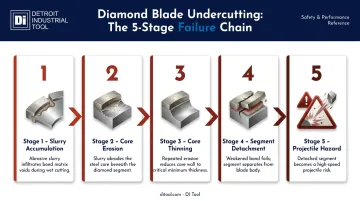
This progression is largely invisible until failure — no dramatic warning, just a thinning core that eventually cannot support the load.
Why Reinforced Concrete Is Higher Risk
Standard concrete is already an abrasive material. The silica aggregate produces fine, hard particles during cutting that form the slurry responsible for core erosion. Reinforced concrete adds three compounding hazards:
- Higher slurry volume — dense aggregate in cured concrete generates more abrasive fines per cut than softer or green concrete
- Rebar strike shock loads — contact with embedded steel creates sudden impact forces that stress an already-thinning core
- Accelerated failure timeline — the combination of abrasive slurry and repeated rebar impacts compresses the window between early wear and segment detachment
The Engineering Response: Undercut Protection Features
Those compounding hazards are why segment geometry matters as much as diamond grade. Blade manufacturers address undercutting directly through designs that reduce slurry accumulation beneath cutting segments. Three common approaches appear across manufacturer catalogs:
- Deep segments — extend further toward the core, shrinking the exposed steel surface that slurry can reach
- Drop segments — positioned at intervals to clear slurry channels and shield the core between primary cutting segments
- Hammer segments — alternating heights create a breaking action that disrupts slurry buildup and distributes wear across more of the blade circumference
When evaluating blades for reinforced concrete, these features — whatever trade name a manufacturer uses — are the primary engineering defense against undercutting.
Safety Guidelines for Diamond Blades on Reinforced Concrete
Safe cutting on reinforced concrete requires several layers working together: blade specification, machine setup, operating discipline, and environmental awareness. Removing any single layer increases failure risk.
General Safety Precautions
Minimum PPE for reinforced concrete cutting:
- Face shield: rated for projectile impact (safety glasses alone are insufficient)
- Hearing protection: required for all powered saw operations
- Cut-resistant gloves: for blade handling and material positioning
- Steel-toed boots
- N95 respirator minimum — OSHA's Silica Standard (29 CFR 1926.1153) requires engineering controls for crystalline silica exposure, including integrated water delivery for many saw tasks; where wet cutting is not possible, respiratory protection is mandatory
Three machine-setup rules with no exceptions:
- The blade guard must never be removed or modified
- The blade's rated RPM must meet or exceed the saw's operating RPM — running a blade above its rated speed is a documented cause of segment and core separation
- The arbor hole must match the saw spindle exactly — a loose fit causes runout that concentrates stress unevenly across segments
Where possible, use a rebar locator or concrete scanner before cutting to map embedded reinforcement. Anticipating a rebar strike is far safer than encountering one unexpectedly at full cutting depth.
Safety During Setup and Blade Installation
Pre-cut inspection is the most important step most operators skip. Before installing any blade on a reinforced concrete job:
- Examine the core in the zone directly beneath every segment
- Look for visible grooves, thinning, discoloration, or channel formation
- Any of these signs indicate prior undercutting — the blade should not be installed
Correct mounting matters as much as blade selection. Install the blade per the directional arrow marked on the blade body. Ensure flanges are clean and undamaged. Tighten fasteners to the manufacturer's specified torque — improper mounting creates runout that concentrates segment stress on specific points, accelerating undercutting at those locations.
Safety While Cutting
Control feed rate. Forcing the blade through reinforced concrete overloads segments and traps slurry beneath them. Let the blade advance at a pace where the diamonds are doing the cutting — not being dragged through the material.
Pause on long cuts. Stopping periodically allows the blade to cool and lets slurry clear from the cut path. This matters most during dry cutting, where there is no water to flush abrasive material away. Skipping this step risks glazing, where the diamond surface polishes instead of cuts, and can cause thermal damage that weakens segment attachment.
Stop and inspect if you notice:
- Cutting speed has slowed noticeably without other explanation
- Vibration has increased beyond baseline
- Unusual noise (grinding, thumping, or squealing)
These are not signs of a "dull" blade to be pushed through. They are warning signs of undercutting or segment damage. Remove and inspect the blade immediately.
Wet vs. Dry Cutting on Reinforced Concrete
Wet cutting with a continuous water supply flushes abrasive slurry away from beneath the segments — directly attacking the mechanism that causes undercutting. It is the preferred method for reinforced concrete wherever setup permits.
Dry cutting concentrates slurry contact. Use it only with blades specifically engineered for dry use with undercut protection features, and pause regularly to clear debris from the cut path.
For deep cuts through thick reinforced slabs, avoid attempting full depth in a single pass. Multiple shallower passes reduce per-pass undercut exposure and give both the blade and operator better control through each cut.
How to Choose a Diamond Blade with Undercut Protection for Reinforced Concrete
Bond Hardness: Match the Matrix to the Material
Bond hardness determines how quickly the metal matrix holding the diamonds wears away. The principle is counterintuitive: abrasive materials require harder bonds.
In abrasive, silica-rich reinforced concrete, a soft-bond blade releases diamonds too quickly, depleting the segment before it can do useful work and leaving the core exposed to slurry contact sooner. A hard-bond matrix resists this wear, holding diamonds in place longer and maintaining the segment geometry that protects the core.
Using a soft or medium-bond blade on hard, dense reinforced concrete is one of the fastest routes to accelerated undercutting.
Key Blade Features to Verify
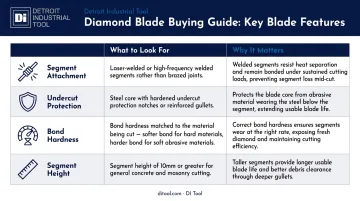
When reviewing blade packaging or spec sheets for reinforced concrete applications, check for:
| Feature | What to Look For | Why It Matters |
|---|---|---|
| Segment attachment | Laser-welded (not sintered) | Stronger core bond, lower segment-loss risk in demanding applications |
| Undercut protection | Drop, deep, or hammer segments | Reduces slurry accumulation beneath standard segments |
| Bond hardness | Hard bond designation for abrasive concrete | Resists accelerated wear from silica fines and rebar contact |
| Segment height | Taller segments for high-volume cutting | More diamond depth = longer usable blade life |
Diameter and Cutting Depth
Blade diameter must provide enough exposed cutting depth after accounting for flange coverage. Undersizing a blade forces the operator to run deeper than intended, increasing segment stress in the zone where undercutting accelerates fastest. Verify the blade's rated cutting depth against your slab thickness before starting.
DI Tool's concrete blade range covers segmented cured concrete and heavier-duty pro series options. Their team can match a specific blade specification to your reinforced concrete job rather than pointing you toward a general-purpose blade.
Common Safety Mistakes to Avoid
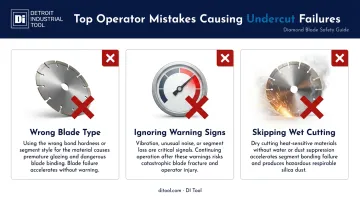
Three operator habits account for most preventable undercut failures on reinforced concrete jobs:
Using a general-purpose or asphalt-rated blade. These blades aren't bonded for the combined abrasion of silica fines and rebar contact. Their cores thin faster — often without visible warning. The 2009 incident involving an asphalt/green concrete blade used on cured concrete, which resulted in 23 of 27 segments ejecting, is a documented example of this failure mode.
Forcing a blade that shows warning signs. Slowing cut speed and increased vibration are commonly misread as blade dullness. On reinforced concrete, they typically signal undercutting. Applying more pressure doesn't restore performance — it accelerates segment detachment.
Skipping wet cutting to save setup time. Without water flushing the slurry, abrasive material concentrates beneath the segments and undercutting builds significantly faster. The setup time saved rarely offsets the shortened blade life, reduced control, and elevated risk of mid-cut failure.
Conclusion
Safe diamond blade operation on reinforced concrete depends on three things working together: the right blade specification with verified undercut protection, disciplined operating habits including controlled feed rate and wet cutting where possible, and consistent pre- and post-use inspection.
None of these factors compensates for the others being absent. A well-specified blade still fails if an operator forces it through at the wrong feed rate. Regular inspection catches nothing if operators skip the pre-installation check.
Build blade inspection and undercut monitoring into every job — before installation, during cuts, and after each use. Undercutting progresses beneath the surface with no visible warning. Catching it on inspection is the only point in the process where you can actually act on it.
Frequently Asked Questions
Can you use a diamond blade on concrete?
Yes — diamond blades are the standard tool for cutting concrete in construction and infrastructure work. Industrial diamonds grind through aggregate rather than slicing it, making them far more effective than abrasive or steel blades. Matching the blade spec to concrete type (cured, green, or reinforced) determines both performance and safety.
Will a diamond blade cut rebar in concrete?
Standard concrete diamond blades are not designed to cut rebar. Striking rebar causes shock loads, vibration, and accelerated undercutting — as documented in OSHA incident reports involving rebar strikes that resulted in blade shatter and operator injury. Use blades rated for reinforced concrete to manage rebar contact; if rebar must be cut separately, use a dedicated metal-cutting blade.
What is the best diamond saw blade for concrete?
It depends on the concrete type and cutting method. For reinforced concrete specifically, a laser-welded segmented blade with a hard bond matrix and undercut protection features (drop or deep segments) is the appropriate specification. Soft-bond or general-purpose blades will undercut faster and fail sooner in this application.
What is undercut protection on a diamond blade?
Undercut protection uses engineered segment designs — drop, deep, or hammer segments at intervals around the blade — to reduce abrasive slurry buildup beneath standard cutting segments. This slows steel core erosion and lowers the risk of segment detachment during cutting.
How do I know if my diamond blade is undercutting?
Look for a visible groove or thinning in the blade core directly beneath the segments. Other warning signs include reduced cutting speed without explanation, increased vibration during operation, and unusual noise. Any of these warrants immediate blade removal and close inspection before the cut continues.
Can undercutting on a diamond blade cause injury?
Excessive undercutting weakens the core-to-segment bond until a segment detaches at operating speed, creating a high-energy projectile. OSHA incident records document fatalities and serious injuries from blade fragmentation involving this failure mode — which is why undercut protection and regular inspection are non-negotiable on any reinforced concrete job.