
Granite isn't like ceramic or porcelain. It's a dense igneous rock built mostly from quartz and feldspar, minerals that sit at 6 to 7 on the Mohs hardness scale. That composition is exactly why a standard tile blade struggles: it wasn't designed to survive that kind of abrasion pass after pass. TCNA notes that tile rated 7 or higher on the Mohs scale is commonly specified to resist quartz sand, which shows just how demanding granite-level hardness really is.
This guide covers whether a tile saw is the right tool for your project, the exact steps for a clean cut, the blade and safety setup you need, the mistakes that ruin most DIY attempts, and when to call in a pro instead.
Key Takeaways
- A tile saw cuts granite fine with a diamond blade rated for stone, not ceramic
- Wet cutting isn't optional: it cools blades, prevents cracking, and cuts dust levels
- Continuous rim blades leave the cleanest edge; turbo rims cut faster but rougher
- Clamping and slow feed pressure matter more than the saw brand you buy
- Small jobs like backsplash pieces are DIY-friendly, but slabs and polished edges need a pro
Can You Cut Granite With a Tile Saw?
Short answer: yes. A standard wet tile saw, fitted with the right blade, cuts granite tile cleanly and safely. The catch is that "right blade" is doing a lot of work in that sentence.
Granite is an igneous rock made up mostly of quartz and feldspar, with smaller amounts of mica and other minerals mixed in. Quartz sits at Mohs hardness 7; potassium feldspar comes in around 6. That's demanding material for any blade built without stone cutting in mind.
Not all ceramic and porcelain tile is dramatically softer than granite, despite common assumptions otherwise. Some porcelain is rated 7 or higher on the Mohs scale specifically to resist scratching. What actually separates granite cutting from everyday tile cutting isn't hardness alone. It comes down to blade construction:
- Bond hardness: granite blades use a softer metal bond that wears away to expose fresh diamonds as granite dulls them
- Diamond concentration: stone-rated blades pack more diamond into the rim to survive granite's density
- Cooling demand: granite generates more frictional heat under the blade than glazed ceramic does
A tile saw fitted with a blade built for stone, like DI Tool's J-Slot Premium Diamond Blade for porcelain and granite tile, is a very different tool. Swap in a bargain ceramic-only blade on that same saw, and performance drops fast.
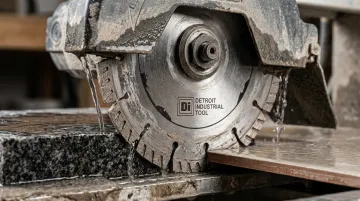
Blade choice solves the cutting problem, but material thickness sets its own limit. This applies to granite tile specifically, typically 3/8 to 1/2 inch thick. Full countertop slabs, often 1 1/4 inch or thicker, push most benchtop tile saws past their depth-of-cut rating. That's a job for the slab-specific equipment covered later in this guide.
Tile Saw vs. Circular Saw: Which Wins for Granite?
Two tools handle most granite tile work: a stationary wet tile saw and a handheld wet circular saw. Both need a diamond blade and constant water flow. That requirement doesn't change based on which one you pick.
| Feature | Stationary Wet Tile Saw | Handheld Wet Circular Saw |
|---|---|---|
| Best for | Small tiles, precise straight cuts | Slabs, on-site trimming |
| Portability | Sliding table, stays put | Lightweight, moves to the work |
| Example capacity | Rail saws like Husqvarna's TS 73 R handle up to 730 mm cut length and 50 mm depth | DeWalt's DWC860W cuts granite up to 1-3/8 in. deep at just 6.6 lb |
| Cut style | Table guides the tile through the blade | You guide the blade across the material |
A tile saw's sliding table delivers repeatable, straight cuts on small pieces, which is ideal when resizing a dozen backsplash tiles to the same dimension. A circular saw trades that precision for reach: you can trim a slab in place or make a cut where a stationary table won't fit.
Both formats live or die on the same two things: a granite-rated diamond blade and a steady stream of water hitting the cutline. Swap either one in without those, and results look identical, scorched and chipped.
When a Tile Saw Is the Right Call
Reach for a stationary wet tile saw when you're:
- Trimming backsplash tile to fit around outlets, corners, or cabinet edges
- Resizing a batch of tiles for a DIY kitchen or bath refresh, since the sliding table repeats each cut identically
- Making straight, repeatable cuts on pieces under roughly 24 inches, where the rail keeps every edge square
These jobs play to a tile saw's core strength: a fixed guide that turns a repetitive cut into a predictable one. Once a project moves outside that lane, though, the same rigidity starts working against you.
When It Isn't
Rethink the tile saw approach if your project involves:
- Thick slabs: most benchtop saws max out around 2 inches of depth
- Bullnose or polished edges: these need dedicated edge-polishing equipment, not a straight blade pass
- Large-volume cuts: a full kitchen's worth of countertop work suits slab saws better
- Complex cutouts: sink holes and curved notches are safer left to a pro's bridge saw
If your project checks any of those boxes, skip ahead to the alternatives section below.
Step-by-Step: How to Cut Granite Tile With a Wet Tile Saw
Skipping steps or doing them out of order is exactly how a granite tile ends up in the scrap pile. Follow this sequence and you'll get a clean edge on the first pass.
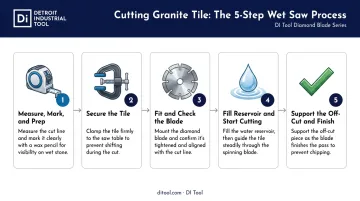
- Measure, mark, and prep. Measure twice. Mark your cutline with painter's tape and an indelible marker; a regular pen or pencil line washes off the moment water hits the tile. If the cut needs to land within a millimeter, account for the blade's kerf width (the material the blade removes) before marking.
- Secure the tile or slab. Use the saw's built-in clamp, or add C-clamps every couple of feet on longer pieces. The underside needs full support along its entire length, since an unsupported section is where granite snaps mid-cut. Narrow strips and thin tile need extra bracing; they flex more and break faster than a full-size piece.
- Fit and check the blade. Confirm the blade mounted on the saw is a continuous rim diamond blade rated for granite or stone, not a ceramic-only blade. Spin it by hand before powering on and check for wobble, warping, or missing segments. Any of those three will chip the tile no matter how careful your technique is.
- Fill the reservoir and start the cut. Fill the water reservoir to the fill line and confirm water is flowing over the blade before it touches the tile. Start slow and steady along your marked line. Let the blade do the work; forcing it generates heat, and heat is how cracks start.
- Support the off-cut and finish. Brace the cut-off piece as you approach the end of the pass. Unsupported off-cuts snap right at the finish line. Power down and let the blade come to a complete stop before lifting any pieces, then wipe down slurry with a damp rag and drain the reservoir.
Blade Selection and Wet vs. Dry Cutting: The Two Variables That Matter Most
The saw brand you buy matters far less than two decisions: which blade rim you fit, and whether you cut wet or dry. Get those two right and most granite-cutting mistakes disappear on their own.
Continuous Rim vs. Turbo vs. Segmented Blades
Three rim styles show up on granite-rated blades, and picking the wrong one is the single biggest cause of chipped edges:
- Continuous rim: smooth, uninterrupted edge that avoids the small impacts that chip tile; the go-to for cuts that stay visible, like a backsplash edge
- Turbo rim: a corrugated continuous design that cuts hard granite faster but leaves a slightly rougher finish, commonly recommended for extremely hard materials
- Segmented rim: gullets between segments clear debris and cool fast, but they're built for rough material like concrete; skip these for finished granite tile work
DI Tool's Turbo Porcelain Tile Diamond Blade uses a continuous turbo rim with semi-wide teeth built for porcelain, ceramic, granite, and marble, and it's stocked in 4-inch through 10-inch diameters to fit most tile saw setups.
Is It Better to Cut Granite Wet or Dry?
Wet, every time. Dry-cutting granite is messier, and it's a documented health risk.
OSHA workplace air-quality studies of granite fabrication shops found respirable crystalline silica levels of under 40 to 770 micrograms per cubic meter with dry methods, dropping to under 20 to 100 micrograms per cubic meter once wet-cutting methods were introduced.
Water does double duty here: it cools the blade so it doesn't overheat and crack the tile, and knocks silica dust out of the air before you breathe it in.
Dry-cut granite also runs hotter, dulls blades faster, and chips more often right at the exit point of the cut.
Feed Speed and Sourcing a Reliable Blade
Forcing the blade through granite generates heat and binding, and that combination is what cracks tile at the exit point. Slow, steady passes, especially at the start and finish, cut down chipping considerably.
A quality diamond blade with a heat-resistant build, such as DI Tool's S-Line Multi-Cut with its vented segment pattern designed to reduce heat buildup, holds up across dozens of granite cuts. Bargain blades glaze over and dull fast, which means more pressure needed to keep cutting: exactly the wrong direction for granite work.
Troubleshooting Common Granite-Cutting Mistakes
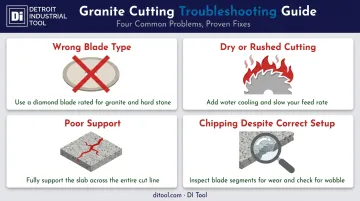
Most problems trace back to one of four issues:
- Wrong blade type: a ceramic-rated blade on granite wears rapidly and chips heavily. Only a stone-rated diamond blade belongs on this material.
- Dry or rushed cutting: overheating cracks tile from thermal stress. Smoke, a burning smell, or a labored motor sound all signal that water flow has stopped.
- Poor support: an unbraced tile or off-cut snaps instead of cutting cleanly. Brace both sides of the line, especially near the finish.
- Chipping despite the right setup: check for blade wobble or warping first, then slow your feed speed further, and confirm the tile is clamped with zero vibration.
Alternatives to Cutting Granite With a Tile Saw
A tile saw isn't the only option, and it isn't always the right one.
Angle Grinder With a Diamond Cutting Disc
Better for irregular cuts, notches, or curves a stationary tile saw table can't accommodate. The trade-off is control: freehand grinder work takes more skill, and without a guide, it's easy to wander off the line and end up with an uneven edge.
Professional Slab or Bridge Saw Service
Best suited for large volumes of granite, bullnose or polished-edge finishing, or high-value slabs where a mistake gets expensive fast. Accredited fabricators run equipment most home shops don't have: bridge saws for slab cutting plus dedicated edge-polishing machines for finishing work a straight blade pass can't replicate. The trade-off is added cost and scheduling, plus giving up full DIY control, in exchange for professional-grade precision and finish quality a home saw can't match.
For most home granite tile projects, such as backsplashes, small resizing jobs, or a handful of pieces, a tile saw with the right blade and a steady water supply remains the most accessible route. Save the alternatives above for slabs, polished edges, or cuts your table just wasn't built to make.
Frequently Asked Questions
What saw is best for cutting granite?
A wet tile saw fitted with a continuous rim diamond blade handles tile-sized pieces best. For larger slabs or on-site trimming, a wet circular saw is the more practical choice.
Will a tile saw cut through granite?
Yes, provided it's fitted with a diamond blade rated for stone and run with continuous water cooling. A standard ceramic blade won't hold up to granite's density.
Is it better to cut granite wet or dry?
Wet cutting is strongly recommended. It cools the blade, prevents thermal cracking, and controls hazardous silica dust. Dry cutting should be avoided entirely.
Can a regular tile saw blade cut granite?
Not well. Ceramic or porcelain-rated blades dull rapidly and chip granite badly. Only a stone-specific diamond blade should touch this material.
How do I avoid chipping when cutting granite tile?
Tape the cutline, use a continuous rim blade, cut at a slow controlled pace, and fully support both sides of the tile through the entire pass.
Is it safe to cut granite indoors?
Avoid dry-cutting granite indoors due to silica dust exposure. If you must cut indoors, use a wet saw with proper ventilation and wear a respirator as extra precaution.