The real challenge isn't whether a diamond blade can cut concrete. It's that the wrong blade type, bond hardness, or cutting method leads to premature wear, poor cut quality, or a blade that glazes over mid-job. These mechanics are widely misunderstood, even among experienced tradespeople.
This guide explains how diamond blades actually work on concrete, what variables determine performance, and how to make the right decisions before picking up a saw.
Key Takeaways
- Diamond blades grind through concrete via abrasive action — they don't slice it like a saw tooth
- Bond hardness is the most critical selection variable: soft bond for hard concrete, hard bond for soft concrete
- Green concrete (8–48 hours after setting) requires a hard-bond early entry blade, not a standard blade
- Wet cutting extends blade life and controls silica dust; dry cutting suits shallow or intermittent jobs
- RPM must match the blade's rated maximum — exceeding it risks segment loss and blade failure
What Is a Diamond Blade and Can It Cut Concrete?
A diamond blade is a circular saw blade with synthetic diamond crystals embedded in metal segments — called the matrix — along its cutting edge. Unlike serrated blades, it works as a precision abrasive tool.
What makes diamond blades uniquely suited to concrete is their abrasive mechanism. Steel saw blades chip and fracture against dense, rigid materials. Diamond blades erode them — grinding through concrete, masonry, and stone without cracking the workpiece.
The Three Main Blade Types
| Blade Type | Construction | Best For |
|---|---|---|
| Segmented | Individual segments with gullets between them | Fast, rough cuts in concrete; dry or wet use |
| Turbo | Continuous serrated rim with wave pattern | Balanced speed and finish; wet or dry |
| Continuous rim | Smooth unbroken rim | Precision finish cuts; less common for concrete |
For most concrete work, segmented blades are the go-to. The gullets between segments serve a dual purpose: debris evacuation and heat dissipation. Turbo blades offer cleaner cuts with less chipping — useful when cut quality matters as much as speed.
That said, diamond blades are designed strictly for mineral and masonry materials. Wood or soft plastics generate excessive heat and friction, damaging both the blade and workpiece. Manufacturer recommendations always specify the intended material range — verify compatibility before cutting anything outside concrete, stone, or masonry.
How Does a Diamond Blade Cut Concrete?
Diamond blades don't slice through concrete — they grind it. That distinction drives every decision about blade selection and operating technique.
The Abrasive Grinding Mechanism
As the blade rotates at high speed, exposed diamond crystals on each segment abrade the concrete surface. The diamonds don't slice through aggregate — they fracture and erode it particle by particle.
This leads directly to the self-sharpening cycle, which extends the blade's lifespan. As surface diamonds dull, the surrounding metal bond matrix gradually wears away, releasing spent diamonds and exposing fresh, sharp ones embedded deeper in the segment. According to Norton Abrasives, this bond tail trailing behind each exposed diamond is critical to how the blade stays sharp across its full lifespan.
The Role of Bond Hardness
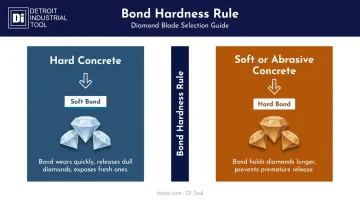
Bond hardness — the metal powder matrix that holds the diamonds — is the single most critical variable in concrete cutting. The rule is counterintuitive at first:
- Hard concrete → soft bond: The bond must wear quickly enough to release dull diamonds and expose fresh ones. If the bond is too hard, diamonds glaze over and the blade stops cutting.
- Soft or abrasive concrete → hard bond: A harder bond holds diamonds longer so they aren't released before they've done their work.
Aggregate hardness works the same way. Hard aggregate dulls diamonds faster — those blades need softer bonds to keep fresh cutting surfaces exposed. Soft aggregate wears the bond down quickly, so harder bonds preserve diamond retention.
Heat and Cooling During the Cut
Friction between the blade and concrete generates significant heat. Left unmanaged, this damages the bond matrix, warps the steel core, or causes segment loss — which is a serious safety hazard.
Wet cutting uses a continuous water supply to cool the blade, remove slurry, and control silica dust. It's preferred for deep or sustained cuts in cured concrete.
Dry cutting requires no water but demands careful heat management. The blade must periodically spin freely outside the cut to dissipate heat. Never run a wet-only blade dry — the consequences range from glazing to catastrophic segment failure.
Choosing the Right Diamond Blade for Concrete
Blade selection starts with knowing your concrete. Three variables drive the decision:
- Compressive strength — harder concrete needs a softer bond
- Aggregate type — hard aggregate accelerates diamond wear; soft aggregate does the opposite
- Cure state — green concrete behaves differently from fully cured concrete
Green Concrete
Diamond Products defines green concrete as freshly poured concrete generally considered green for 8 to 48 hours after it has set. The challenge: unbonded sand in the mix acts as an abrasive that wears blade bonds aggressively. Green concrete requires a hard-bonded early entry blade — a standard blade will wear out prematurely.
Husqvarna notes that early entry sawing should begin as soon as the concrete can support the saw and operator without damage. Getting the timing right prevents random cracking.
DI Tool's early entry blade line uses a color-coded bond system that makes this selection straightforward:
- Purple — Very Soft Bond (hardest concrete)
- Green — Soft Bond
- Red — Medium/Soft Bond
- Orange — Medium Bond
- Yellow — Medium/Hard Bond (softest concrete)
This five-tier system lets contractors match bond to concrete condition precisely.Cure state is one variable — reinforcement is another.
Reinforced Concrete
Cutting through rebar-embedded concrete puts dual demands on the blade — it must handle both the concrete matrix and the steel bars. A blade rated only for concrete will degrade quickly when it hits steel reinforcement.
DI Tool's S-Line Multi-Cut Diamond Blade addresses this directly, with laser-welded turbo segments engineered for reinforced concrete, hard stone, and similar mixed-hardness materials. When transitioning through rebar, reduce forward pressure — the blade should maintain contact without being forced through the steel.
RPM Compatibility
Every diamond blade carries a maximum RPM rating. Running below the recommended range reduces cutting efficiency and shortens blade life. Exceeding maximum RPM risks segment loss and blade failure.
Diamond Products illustrates how this varies by diameter:
| Blade Diameter | Max RPM (Dry) |
|---|---|
| 4 inch | 15,000 RPM |
| 14 inch | 5,400 RPM |
Larger blades require lower speeds. Always verify the blade's RPM rating matches the saw's output before starting — check at full throttle, no load, and operating temperature.
How to Cut Concrete with a Diamond Blade
Safety and Setup
Concrete cutting generates respirable crystalline silica dust. OSHA 29 CFR 1926.1153 sets the permissible exposure limit at 50 µg/m³ and the action level at 25 µg/m³, both as 8-hour TWA values.
Required PPE before starting:
- Respirator: Minimum N95 for outdoor cuts under 4 hours; APF 10 respirator required for indoor or enclosed cutting
- Eye protection: Safety goggles
- Hearing protection: Ear protection for sustained cutting
- Foot protection: Steel-toe boots
After installing the blade, run a no-load test. Excessive vibration or unusual noise before the blade contacts concrete indicates a mounting problem — stop and inspect before proceeding.
Cutting Technique
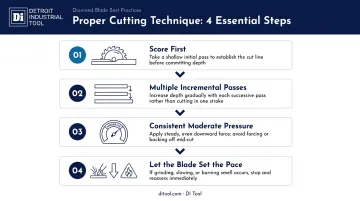
- Score before committing to depth. Start with a shallow pass to establish the cut line. Plunging straight to full depth puts unnecessary stress on the blade and increases the chance of blade walk.
- Make multiple passes, incrementally deeper. Each pass lets the blade track cleanly in the kerf rather than fighting the full material thickness at once.
- Apply consistent, moderate forward pressure. The diamonds do the cutting. Forcing the blade accelerates wear and causes overheating — if resistance increases, ease off rather than push harder.
- Let the blade set the pace. Grinding, slowing, or burning smell all signal the blade needs a moment to cool or dress before continuing.
Managing Heat in the Field
- Dry cutting requires active cooling intervals. Every 30–60 seconds, lift the blade out of the cut and let it spin freely for several seconds before resuming.
- Wet cutting demands a continuous water supply for the full duration. Running a wet-rated blade dry — even briefly — can crack the blade or strip the segment bond.
- Glazed blade symptoms (the blade spins but barely scratches the surface) mean the bond has sealed over the diamonds. A few passes through a silica brick or dressing block wears the bond back and re-exposes fresh cutting material. Normal maintenance, not a sign of failure.
Frequently Asked Questions
How long will a diamond blade last cutting concrete?
Blade life varies significantly based on concrete hardness, aggregate type, wet vs. dry cutting, and blade quality. Industry benchmarks show outputs of roughly 1,000 inch-feet for basic blades, 5,000 for better quality, and 10,000 for premium blades. Correct bond selection, adequate cooling, and avoiding overspeed are the primary factors that extend lifespan.
What blade cuts concrete best?
Segmented diamond blades are the top choice for most concrete work, with wet-cutting segmented blades preferred for deep cuts in cured concrete. For green concrete, a hard-bond early entry blade is required. For reinforced concrete, use a blade rated for both concrete and steel, such as a laser-welded turbo-segment blade.
What material cannot be cut by a diamond cutting tool?
Diamond blades perform poorly on soft, fibrous materials like wood and most plastics. The abrasive grinding action generates excessive heat on these materials instead of the controlled erosion that works on stone and concrete. Manufacturer application specifications always list mineral and masonry materials, not organics.
Can you cut concrete with a diamond blade on an angle grinder?
Yes, for shallow or smaller-scale cuts, provided the blade is rated for the grinder's RPM and diameter. A 4-inch dry-cut segmented blade on a compatible grinder can reach around 1 inch of cutting depth. Angle grinders aren't suitable for deep cuts in thick slabs — use a dedicated masonry saw for that work.
Should I cut concrete wet or dry?
Wet cutting is preferred for deep, sustained cuts in cured concrete — it extends blade life and controls silica dust exposure. Dry cutting suits intermittent, shallow, or indoor cuts where water management is impractical. Never use a wet-only blade dry, even briefly.
Can a diamond blade cut reinforced concrete with rebar?
Yes, but the blade must be rated for both concrete and steel. Reduce cutting pressure when passing through rebar and expect faster wear than on plain concrete. A blade designed only for concrete will degrade quickly on steel reinforcement. Use a laser-welded turbo-segment blade or one explicitly rated for reinforced concrete.
Conclusion
Diamond blades cut concrete through controlled abrasive grinding — not mechanical slicing. Every decision about blade type, bond hardness, wet vs. dry method, and RPM flows from that single mechanism.
The difference between a clean, efficient cut and a prematurely worn blade comes down to matching the blade to the concrete: know the aggregate hardness, whether you're cutting green or cured material, your tool's RPM rating, and how you'll manage heat throughout the cut. Nail those four variables and the blade does the rest — reliably, cleanly, and without premature wear.