
Diamond blades solve this problem by grinding through ceramic rather than shearing it. But not every diamond blade delivers the same result — rim type, bond hardness, and wet/dry compatibility all determine whether you walk away with clean edges or a pile of cracked tile.
This guide covers the five best diamond blades for ceramic tile, explains how each blade type performs, and gives you a practical framework for matching the right blade to your saw, your tile, and your project.
Key Takeaways
- Continuous rim blades are the standard for glazed ceramic tile — smooth grinding action prevents surface chipping
- Turbo rim blades cut faster on thicker or denser ceramic when edge perfection matters less than speed
- Segmented blades are not suitable for standard glazed ceramic — they cause cracking and chipping
- Blade size, arbor, and RPM rating must match your specific tool before installing
- Wet-rated blades require water cooling — dry use destroys the diamond bond
Why Diamond Blades Work on Ceramic Tile
Ceramic tile has a hard glazed surface that dulls standard saw blades quickly and generates heat that causes cracking. Diamond blades handle both issues through a fundamentally different cutting mechanism.
According to MK Diamond, diamond blades don't actually "cut" in the conventional sense — they grind. A bonding matrix on the blade's rim embeds synthetic diamond crystals that abrade the tile surface with controlled friction, removing material gradually rather than shearing it. This protects brittle glazed surfaces from the shock that causes chipping.
That bonding matrix also wears away at a controlled rate, exposing fresh diamond crystals as cutting progresses. The result is consistent material removal across the blade's lifespan — provided the bond hardness is matched to the tile's properties.
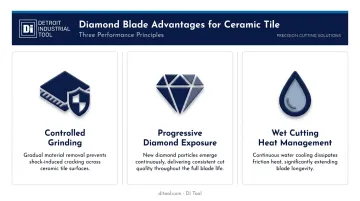
Three reasons diamond blades outperform alternatives on ceramic:
- Controlled grinding prevents the shock-induced cracking that abrasive or carbide blades cause
- Progressive diamond exposure keeps cut quality steady across the full blade life
- Wet cutting versions use water flow to manage heat buildup and extend blade longevity
Choosing the right blade reduces tile waste, speeds up installation, and produces the clean edges that professional work demands. The five blades below cover the top options across performance, durability, and value for ceramic tile specifically.
Top 5 Best Diamond Blades for Cutting Ceramic Tile
These blades were selected based on cut quality on ceramic tile, blade longevity, tool compatibility, and overall value for both professional installers and DIY use.
1. Diablo Tools Continuous Rim Diamond Blade
Diablo Tools is one of North America's leading blade manufacturers, known for high-performance diamond products used widely across tile and masonry applications. Their DMADC series continuous rim blades are engineered specifically for smooth, chip-free cuts on ceramic, porcelain, and natural stone.
| Spec | Detail |
|---|---|
| Rim Type | Continuous rim for smooth ceramic cuts |
| Sizes Available | 3", 4", 4.5", 5", 7", 10" |
| Arbor (10") | 5/8" |
| Max RPM (10") | 6,150 RPM |
| Wet / Dry | Wet recommended |
The laser-cut steel core controls vibration, and the blade's 1.6mm kerf on the 10" model keeps cuts precise. Compatible with standard 5/8" and 7/8" arbors depending on size, and widely available at major tool retailers.
2. Rubi CEV Continuous Rim Diamond Blade
Rubi Tools is a globally recognized specialist in tile installation equipment. Their CEV continuous rim blade is specifically engineered for general cutting of ceramic tiles, with a bond formulation and rim geometry optimized for glazed ceramic rather than adapted from a broader masonry lineup.
| Spec | Detail |
|---|---|
| Rim Type | Continuous rim |
| Application | Ceramic tile — wet cutting |
| Category | Wet diamond blades |
| Best For | General ceramic tile; residential and commercial tile saws |
Rubi's CEV blade is purpose-built for standard glazed ceramic on wet tile saws — making it the most application-specific choice in this list for straightforward residential and commercial ceramic work.
3. DeWalt Continuous Rim Wet Diamond Blade
DeWalt is one of the most recognized professional tool brands worldwide, and its diamond blade line is built for contractors who run their equipment hard. The DW4760 (7") and DW4761 (10") are the primary ceramic tile-rated blades in DeWalt's lineup.
| Spec | Detail |
|---|---|
| Rim Type | Continuous rim |
| Sizes Available | 7" (DW4760), 10" (DW4761) |
| Arbor (10") | 5/8" |
| Max RPM (DW4761) | 6,000 RPM |
| Key Feature | Laser-cut expansion slots resist heat-induced warping |
The tensioned steel core resists warping under sustained wet cutting — a real advantage on larger jobs where the blade runs continuously. DeWalt backs the DW4761 with a 30-day money-back guarantee, adding low-risk confidence for contractors trialing it on a new project.
4. QEP Pro Series Continuous Rim Diamond Blade
QEP is a contractor-focused brand built into the flooring and tile installation trade. Their Pro Series continuous rim blades prioritize value without sacrificing performance on standard ceramic.
| Spec | Detail |
|---|---|
| Rim Type | Continuous rim |
| Sizes Available | 4" (6-4001Q), 7" (6-7003Q), 10" (6-1001Q) |
| Arbor (4") | 5/8" – 7/8" |
| Max RPM (4") | 15,000 RPM |
| Max RPM (7") | 8,730 RPM |
| Best For | Value-focused contractors; standard ceramic floor and wall tile |
QEP's 4" ceramic blade is explicitly engineered for ceramic tile wet cuts with minimal chipping — the 10" version at 6,115 RPM suits larger tile saws. For large residential projects or light commercial work, the Pro Series delivers competitive cuts-per-dollar that outpaces most mid-range blades in its price tier.
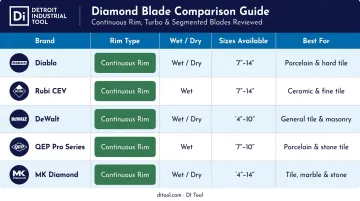
5. MK Diamond Continuous Rim Tile Blade
MK Diamond has been a fixture in the tile saw industry for decades. Their continuous rim tile blades are formulated with a bond hardness matched specifically to ceramic tile — a bond characteristic that extends blade life by releasing diamonds at the correct rate for ceramic's material properties.
| Spec | Detail |
|---|---|
| Rim Type | Continuous rim |
| Wet / Dry | Both options available |
| Models | MK-215 (hard materials, chip-free), MK-404CR (dry cutting) |
| Notable Strength | Bond hardness matched to ceramic for optimized diamond exposure |
MK Diamond's blade manual confirms that continuous smooth rim blades provide clean, smooth cuts on glazed ceramic tile. The MK-404CR handles dry cutting of hard and vitreous ceramic with minimal heat buildup — one of the few ceramic-specific dry options from an established manufacturer.
Blade Types for Ceramic Tile: What to Know
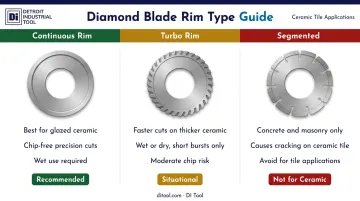
Continuous Rim Blades
The standard choice for glazed ceramic. A solid, uninterrupted diamond edge grinds material without the interrupted contact that causes chipping — this is the blade type consistently recommended for glazed ceramic by major diamond tooling manufacturers.
Use with water cooling. For visible tile applications — countertops, bathroom walls, floor borders — continuous rim is the right call.
Key situations where continuous rim blades perform best:
- Glazed wall and floor tile where surface finish matters
- Precision cuts on decorative or border tile
- Wet saw setups with consistent water flow
Turbo Rim Blades
Turbo blades feature serrated or wave-cut segments along the rim that allow faster material removal and better heat dissipation during cutting. They work on thicker or denser ceramic where speed is the priority and edge finish is secondary.
They can be used wet or dry in short bursts, making them practical for on-site angle grinder work. The tradeoff: the edge won't be as clean as a continuous rim blade on standard glazed tile.
Segmented Blades — Not for Ceramic Tile
Segmented blades are designed for concrete, brick, and hard masonry. The gaps between segments cause impact and vibration on brittle glazed surfaces, resulting in cracking and chipping. If you're cutting ceramic, reach for a continuous rim or turbo blade instead.
How to Choose the Right Diamond Blade for Ceramic Tile
Match Bond Hardness to Your Tile
Using a generic or multi-purpose blade on ceramic is the most common mistake. Ceramic-rated blades are engineered with a specific bond hardness — soft enough that diamonds release at the correct rate as the bond wears. Too hard a bond causes blade glazing (diamonds get polished over and stop cutting); too soft causes premature wear.
For standard glazed ceramic, a medium-bond blade delivers balanced performance and longevity.
Check Blade Size and Arbor Compatibility
- Most wet tile saws accept 7" or 10" blades
- Angle grinders typically use 4" to 4.5" blades
- Common arbor sizes are 5/8" (tile saws) and 7/8" (angle grinders)
The arbor size must match the tool's spindle precisely. A poor fit causes wobble, leading to chipped tiles and a genuine safety risk.
Wet vs. Dry Cutting
Continuous rim blades designed for wet cutting should not be run dry for extended periods. Heat destroys the diamond bond from the inside out, and the blade fails well before its rated life.
For dry-cut applications — angle grinder work on site, quick cuts without a water supply — select a blade explicitly rated for dry use. Rubi notes that dry cutting may cause overheating and recommends water or allowing cooling intervals between cuts.
Verify RPM Before Installing
OSHA requires that the rated maximum speed of an abrasive wheel shall not be exceeded. This is both a safety rule and a blade-life issue. Running a blade above its rated RPM accelerates wear and risks blade failure.
Always confirm:
- The blade's marked maximum RPM
- Your tool's operating speed at the spindle
- The blade RPM must equal or exceed the tool's speed
Getting these four factors right narrows your options considerably — and makes the final selection straightforward.
Conclusion
The right diamond blade for ceramic tile comes down to three things: tile type, tool compatibility, and wet or dry use. A continuous rim, ceramic-rated blade with the correct bond hardness will outperform a generic option across cut quality, blade life, and total project cost.
Before purchasing, confirm these specs match your application:
- Rim type (continuous for tile)
- Bond hardness for your tile density
- Blade diameter and arbor size
- Maximum RPM rating for your tool
Don't default to the cheapest option or a familiar brand name if the specs don't align.
DI Tool carries diamond blades for tile and masonry under the Detroit Industrial Tool brand, alongside a full catalog of cutting tools for industrial and construction applications. If you need help selecting the right blade for your project, reach out at info@ditool.com or call (800) 678-8006 — the team can guide you to the right solution for your specific cutting needs.
Frequently Asked Questions
What do professional tilers use to cut tiles?
Most professional tilers use wet tile saws fitted with continuous rim diamond blades — water cooling keeps cuts clean and chip-free on glazed surfaces. Angle grinders with dry-rated diamond blades are also common for on-site adjustments and detail work.
Do you need a special blade to cut porcelain tile?
Yes. Porcelain is significantly denser and more brittle than standard ceramic, so it requires a diamond blade rated specifically for porcelain or hard ceramics. Standard wood or metal blades wear out almost immediately and cause severe edge chipping on porcelain.
What is the difference between a continuous rim and a turbo rim diamond blade for ceramic tile?
Continuous rim blades produce smoother, chip-free cuts ideal for glazed ceramic surfaces. Turbo rim blades have serrated segments that cut faster but leave a slightly rougher edge — they suit thicker or denser ceramic where speed matters more than finish quality.
Can I use a diamond blade dry when cutting ceramic tile?
Only blades explicitly rated for dry cutting should be used without water. Running a wet-rated blade dry causes rapid overheating that destroys the diamond bond — and creates a fire and safety hazard. Always check the blade label before use.
How long does a diamond blade last when cutting ceramic tile?
Blade life varies based on tile hardness, RPM consistency, blade quality, and whether wet cutting is used. Premium blades with higher diamond concentration typically last 2–3x longer than budget options, and consistent water cooling is the single biggest factor in extending blade life.
What size diamond blade is best for a standard tile saw?
Most standard wet tile saws accept 7" or 10" blades, with 7" being the most common size for residential tile work. Always confirm the correct size in your saw manufacturer's manual before purchasing, as running an incorrectly sized blade is a safety hazard.