
Blade shape has become a bigger buying factor as knife use has splintered across everyday carry, hunting, tactical, culinary, and collector markets. A hunter field-dressing game needs something different than a line cook breaking down a chicken or a rescue worker cutting seatbelts.
This guide works as a visual, quick-reference chart. You'll find the most common blade shapes, what each one does well (and poorly), and how to match a shape to your actual needs.
Key Takeaways
- Blade shape (the outline) differs from blade grind (the cross-section); shape decides the job
- Drop point, clip point, tanto, and sheepsfoot dominate EDC, hunting, and tactical categories
- Every shape trades off piercing power, slicing ability, tip strength, and sharpening ease
- The right shape depends on your primary task, not popularity or looks
What Is a Blade Shape and Why Does It Matter?
Blade shape is the two-dimensional profile created by the spine, the cutting edge, and the tip. It's the outline you'd trace if you laid the knife flat and drew around it. This silhouette predicts cutting behavior before the steel type or handle even enter the conversation.
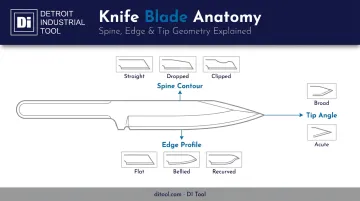
Three visual elements define almost any blade shape:
- Spine contour — straight, gradually dropped, or sharply clipped near the tip
- Edge profile — flat, gently bellied, or recurved (curving inward before flaring out)
- Tip angle — broad and strong versus acute and built for piercing
Why Shape Trumps Steel for Most Buyers
Spyderco's own breakdown of blade profiles makes the point directly: shape determines the performance characteristics and task-suitability of a knife, independent of what steel it's made from (Spyderco's blade shapes guide). A $300 super-steel blade with the wrong geometry for the job still frustrates the user.
Consider the extremes. A fine, acute tip snaps if you try to pry with it, no matter how hard the steel is. A heavily bellied edge struggles to pierce a tarp or cardboard box cleanly, regardless of sharpness. Shape sets the ceiling on what a knife can do well.
How Shapes Get Made
Blade shapes are physically cut through precision grinding and machining, not just sketched on paper. Manufacturers producing consistent, repeatable profiles at scale rely on cutting tools that hold tight tolerances pass after pass.
Companies like DI Tool supply this kind of tooling — coated carbide burs and end mills, including ALTIN, TICN, and ALCRO|MAX coated lines, built for shaping and finishing metal stock where wear resistance and repeatability matter. Toolmakers working at volume depend on tooling that doesn't drift out of spec halfway through a production run.
Once you understand spine, edge, and tip as separate variables, you can look at almost any knife and predict its strengths before you ever pick it up.
Knife Blade Shapes Chart: Types & Uses
The shapes below are grouped loosely by function: general-purpose, piercing/tactical, slicing/skinning, and specialty, so you can find one suited to your task quickly.
| Shape | Best For | Watch Out For |
|---|---|---|
| Drop Point | Hunting, EDC, general use | Thicker tip limits fine piercing |
| Clip Point | Detail work, piercing | Fragile tip under lateral stress |
| Tanto | Tactical, prying, hard use | Minimal belly, poor slicing |
| Sheepsfoot | Push cuts, rescue, safety tasks | No piercing capability |
| Wharncliffe | Precision cuts, whittling | Minimal belly limits slicing |
| Trailing Point | Filleting, skinning | Fragile, elevated tip |
| Spear Point | Controlled piercing, tactical | Modest belly slows slicing |
| Dagger | Thrusting only | Illegal in many areas, no utility use |
| Hawkbill | Rope, cable, self-defense | Hard to sharpen, fragile tip |
| Kukri | Chopping, bushcraft | Heavy, harder to control |
| Recurve | Slicing, chopping efficiency | Very difficult to sharpen |
Drop Point
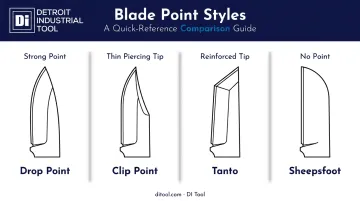
The spine slopes gently downward from handle to tip, creating a strong point backed by a generous belly. It's the most widely available shape on the market, found on everything from Buck hunting knives to budget EDC folders (Buck Knives' blade shape breakdown).
It's versatile for hunting and general use, though the thicker tip isn't optimized for fine piercing work.
Clip Point
Picture a drop point with a concave "clip" cut from the spine near the tip. That clip thins the point dramatically, giving it a sharper profile than a drop point offers. Popularized by Bowie knives, clip points excel at piercing and detail cuts, but the thinner tip is more prone to snapping under lateral pressure.
Tanto
The tanto's angular, two-point profile (a front edge plus a secondary angled edge) reinforces the tip for maximum strength. It handles piercing and prying better than almost any other shape, which is why it shows up on tactical and hard-use knives. The trade-off is minimal belly, which makes it a poor slicer.
Sheepsfoot
A straight edge meets a blunt, rounded tip formed by a sharp curve in the spine, leaving no true point at all. This makes sheepsfoot blades ideal for controlled push-cuts and safety-focused tasks like rescue work and EDC, since the dull tip nearly eliminates accidental punctures.
Wharncliffe
Similar to a sheepsfoot but with a spine that drops gradually to a fine point instead of a blunt one, keeping the tip in line with the edge. It offers precision and easy sharpening for detail and whittling work, though minimal belly limits how efficiently it slices.
Trailing Point
The spine sweeps upward, raising the tip above the handle line and maximizing belly length. This design excels at fillet and slicing tasks, with fishing and skinning knives relying on it constantly, but the elevated, thin tip is fragile and performs poorly at piercing.
Spear Point
A symmetrical profile with the tip sitting on the blade's centerline, often paired with a partial false edge. Common on tactical and OTF (out-the-front) knives, it offers balanced control for piercing and detail work. The modest belly does slow down slicing tasks somewhat.
Dagger
Fully symmetrical with two edges meeting at a centered tip. Built purely for piercing and thrusting, a dagger offers the benefit of double edge retention. It's also illegal to carry in many jurisdictions and largely impractical for everyday utility tasks.
Hawkbill
A sharply inward-curving edge ends in a needle-like tip that resembles a talon. Hawkbills deliver unmatched pull-cut performance on rope, cable, and webbing, and see use in self-defense contexts too. The fragile tip and inward curve make sharpening on flat stones difficult.
Kukri
Forward-weighted with an inward curve that flares into a steep outward belly, the kukri's design puts mass exactly where chopping power matters most. Bushcraft and military users value it for chopping performance few folding or fixed shapes can match, though the heavy blade is harder to control precisely.
Recurve
An "S"-shaped edge curves inward before flaring outward again, increasing usable edge length along the blade. This delivers exceptional slicing and chopping efficiency, almost like a built-in sickle motion. Sharpening is the catch — flat stones can't reach the inward curve, so recurves need rods or specialty sharpeners.
Other Notable Shapes
- Bowie — An elongated clip point built for reach and chopping, associated with classic frontier and outdoor knives
- Spey Point — A near-blunt, straight-edged shape historically used for livestock work, valued for controlled slicing without puncture risk
- Cleaver — A heavy, rectangular blade built for chopping through bone and dense material
- Reverse Tanto — Flips the traditional tanto angle for a stronger tip while keeping more usable edge, popular in modern EDC knives
How to Choose the Right Blade Shape for Your Needs
The "best" blade shape depends entirely on your primary task and environment — not popularity, and definitely not how aggressive a knife looks on a display rack.
Several factors should guide your choice:
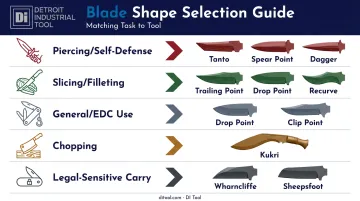
- Match shape to primary task: Piercing-heavy tasks like self-defense or field dressing favor tanto, spear point, or dagger shapes. Slicing-heavy tasks like kitchen prep, filleting, or skinning call for trailing point, drop point, or recurve shapes.
- Weigh tip durability against sharpness: Thinner, more acute tips pierce better but snap more easily under lateral stress. Broader tips trade some piercing ability for durability that holds up to harder use.
- Factor in sharpening maintenance: Straight-edged shapes (wharncliffe, sheepsfoot, straight-back) maintain easily on flat stones. Curved and recurved shapes need rods or specialty sharpeners since a flat stone can't reach the inward curve.
- Check legal restrictions: Double-edged shapes like daggers, along with certain automatic-opening designs, are restricted or illegal to carry in specific states and countries. Rules vary by blade length, edge count, and opening mechanism, so check your local knife laws before buying (AKTI's state-by-state knife law resource).
- Balance versatility against specialization: General-purpose shapes like drop point and clip point handle many tasks reasonably well. Specialty shapes like hawkbill, kukri, or gut hook fit one dominant, repeated use case instead.
Common Mistakes to Avoid When Selecting a Blade Shape
Buyers run into predictable problems when they skip the geometry conversation:
- Buying a tactical-looking shape for everyday tasks. A dagger or kukri looks impressive but struggles with opening mail or breaking down boxes.
- Ignoring sharpening difficulty until it's too late. Recurve and hawkbill edges need rod or ceramic sharpening, and neglected edges often stay dull for good.
- Overlooking regional knife laws. Blade length limits, double-edge restrictions, and automatic-opening rules can turn a legal purchase into a carry violation.
Conclusion
Blade shape, not steel type or handle material, is the single biggest predictor of how a knife performs in the field, the kitchen, or a rescue situation. Dozens of shapes exist because piercing, slicing, chopping, and detail work all demand different geometry. No single shape does everything well, and that's by design.
Whether you're buying your next knife or manufacturing blade blanks at scale, understanding shape geometry matters. So does having access to precision cutting tools that can produce it consistently. DI Tool's coated carbide burs and end mills, including the ALTIN, TICN, and ALCRO|MAX coated lines, support the repeatable shaping and finishing work that keeps blade profiles accurate from the first unit to the ten-thousandth.
Frequently Asked Questions
What are the different types of blades?
Major blade shapes include drop point, clip point, tanto, sheepsfoot, spear point, hawkbill, recurve, and dagger. Each differs based on its tip angle, edge curve, and spine contour, which together determine how it cuts.
What are the 7 types of knives?
Common knife categories by use include pocket/EDC, fixed blade, hunting, tactical, kitchen, survival, and folding knives. This differs from "blade shape," which cuts across every one of these categories.
What is the best blade shape for everyday carry?
Drop point and clip point are the most popular EDC shapes because they balance piercing, slicing, and tip durability well without over-specializing in one direction.
What's the most versatile blade shape overall?
Drop point is the most versatile shape overall, thanks to its combination of tip strength and a generous belly curve that handles most everyday cutting tasks well.
Are certain blade shapes illegal to carry?
Yes. Double-edged daggers and some automatic-opening knives are restricted in various states and countries. Always check local laws before purchasing or carrying one.
What's the difference between blade shape and blade grind?
Blade shape is the outline — the spine, edge, and tip profile you see from the side. Blade grind is the cross-sectional bevel, such as flat, hollow, or convex, and it affects performance differently than shape does.